Invasive species are of increasing concern for global biodiversity, as they disturb local community structure and in extreme cases, may even lead to the extinction of native species. The invasive avian vampire fly (Philornis downsi) is considered one of the greatest threats to the unique and endemic avifauna of the Galápagos. The fly parasitizes nearly every passerine species, including Darwin’s finches, in the Galápagos. We are studying the genomes of various populations of Philornis downsi from multiple islands of Galápagos to examine the evolutionary pathways of invasion.
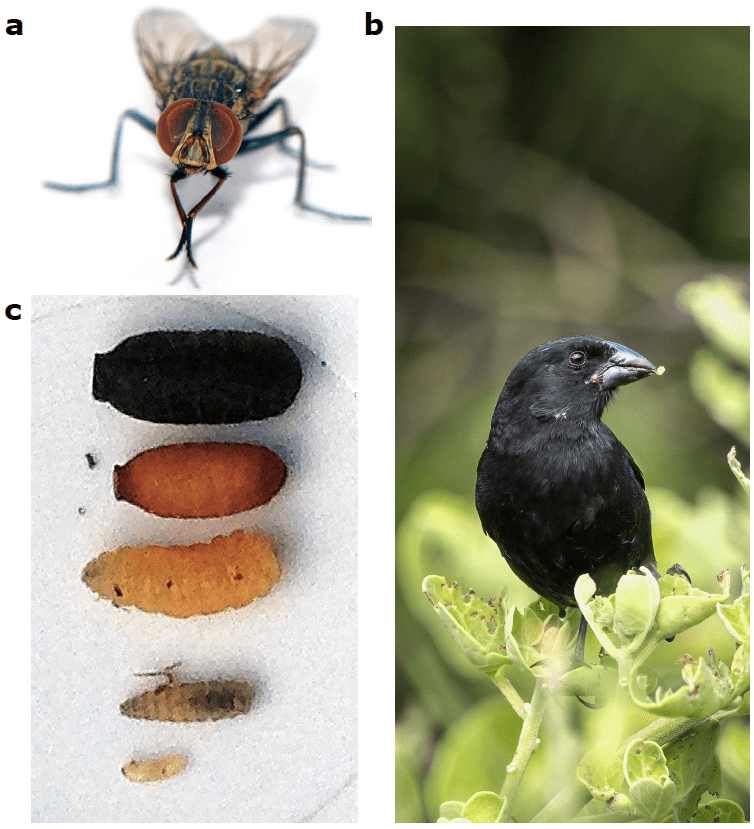
In the early 1960s, an invasive parasitic fly, Philornis downsi, was introduced into the Galapagos and has been causing high mortality in the avian hosts including the Darwin’s finches. Previous studies have shown high rate of mortality in the infected nestings in finches to the level that now it is being considered as a serious threat to Darwin’s finch populations. Together with our collaborators, Dr. Jennifer Koop and Dr. Sarah Knutie, we aim to generate a high-resolution genomic resources for Philornis downsi and carry out population genomics studies to explore the host-parasite co-evolutionary dynamics. This study system will provide us a unique opportunity to monitor the genomic evolution of an invasive species in an island settings in real time.
These genomic resources will serve as the first step toward investigations of this fly’s ability to rapidly evolve traits associated with its successful invasion in the Galápagos. From an applied aspect, these genomic resources will also help inform future research studies and mitigation strategies aimed at minimizing the fly’s impact on the birds of the Galápagos.
 theomicslab.com